Where to publish your first research paper as a high school student
Journals that accept research by high school students, what their review involves and what each one charges, plus how to spot a journal to avoid.
You've finished a research paper. The next question is where to send it. Plenty of journals accept work by high school students, but they differ a lot in who reviews your paper, which fields they take and what they charge. This guide lists journals we checked on their own websites in November 2026. Fees and rules change, so confirm on the journal's site before you submit.
Every journal decides for itself what it accepts. Submitting is never a promise of publication.
Atlas partners
International Journal of High School Research (IJHSR)
IJHSR publishes original research and literature reviews by high school students across three sections. Each paper goes to two or more outside reviewers with expertise in the field: university faculty, STEM professionals, postdoctoral researchers and doctoral students.
- Fields: the natural and physical sciences; engineering and computer science; and business, economics, education, history, law, political science, psychology, sociology and related fields.
- Review papers: yes, but only in-depth, extensive literature reviews, and only two or three per issue.
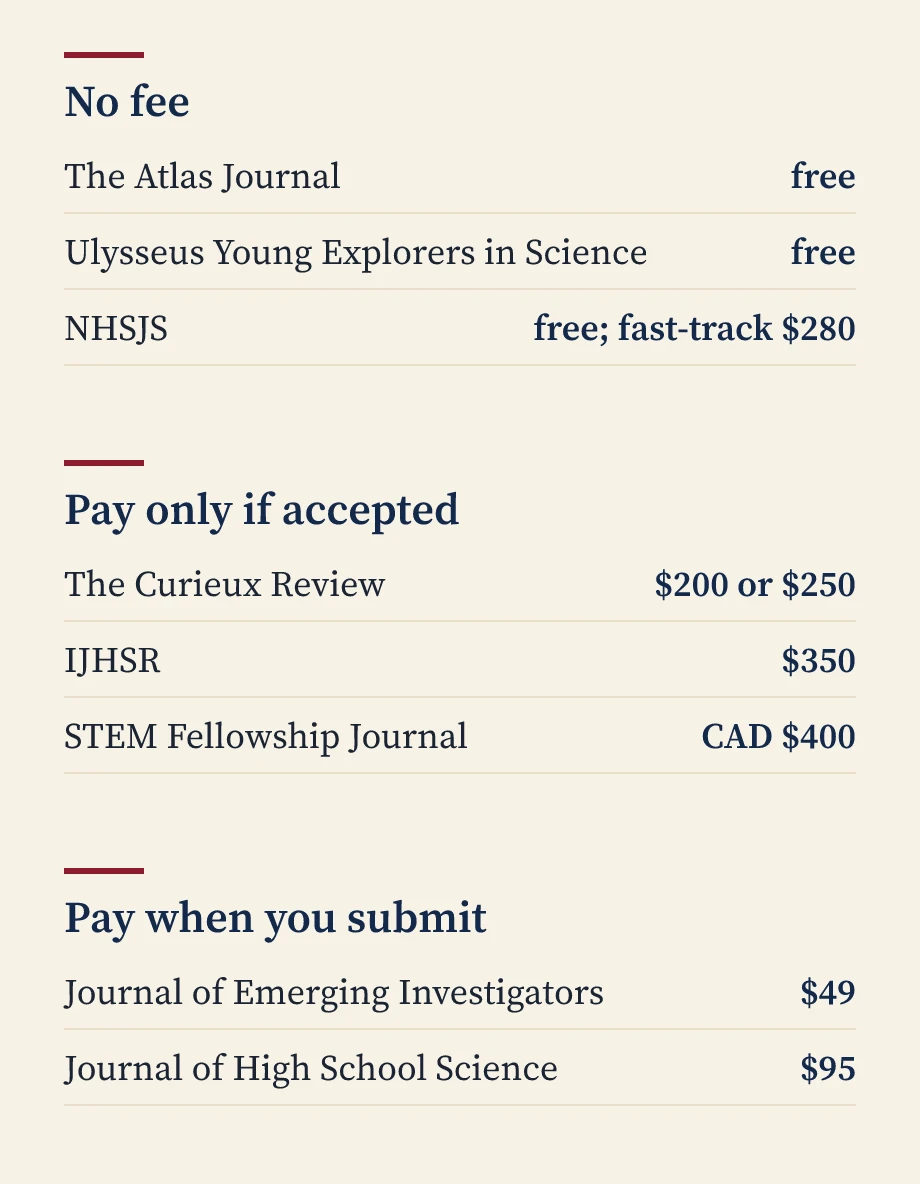
Fee: free to submit. A $350 publication fee is charged only if your paper is accepted. Students in the United States who qualify for free or reduced-price lunch can apply for a full publication scholarship. Submission details
The Curieux Review
The Curieux Review, from the founders of the Curieux Academic Journal, takes papers from middle school, high school and undergraduate students. It is a youth-led journal: two of its editors review each paper separately, with the authors' names removed, and most of its editors are students themselves.
- Fields: any academic subject, from the sciences to the humanities and the arts.
- Review papers: yes, literature reviews and review articles.
Fee: free to submit. If your paper is accepted, publication costs $200 for seasonal review or $250 for fast-track review. Financial aid is available, and authors whose papers are rejected pay nothing. FAQ
The Atlas Journal
The Atlas Journal is where Atlas fellows share their finished papers. Each paper is read by Atlas editors before it goes up. It is not externally peer reviewed, which makes it a good first home for your work while you also submit elsewhere.
- Fields: any field. It publishes papers by Atlas fellows only.
- Review papers: yes. Fellows finish with a research paper, a literature review or a policy brief.
Fee: none.
Other journals that accept high school research
Journal of Emerging Investigators (JEI)
For middle and high school students aged 13 or older, with an adult mentor who submits the paper. Every paper must clearly test a hypothesis. Papers are peer reviewed by volunteers, mostly PhD students and postdoctoral researchers.
- Fields: the natural sciences only: life sciences and experimental physical sciences. It does not take mathematics, computer science, economics, political science or history.
- Review papers: no.
Fee: $49 at submission, the only fee to submit and publish. A waiver is available. FAQ
National High School Journal of Science (NHSJS)
Original research by high school students. Papers are reviewed by one or two peer reviewers (graduate students, postdocs and professional scientists), then by an advisory board of researchers and professors.
- Fields: science; it doesn't list specific subjects.
- Review papers: only systematic literature reviews, not summaries of what is already known.
Fee: the journal describes itself as free, and the only fees it lists are for optional fast-track review, at $280. Check the current terms before you submit. About and peer review
STEM Fellowship Journal
For high school and undergraduate research. An editor checks each paper first, then it goes to double-blind review by a subject expert, such as someone with a PhD or MD.
- Fields: any STEM field.
- Review papers: yes, critical review articles.
Fee: CAD $400 if your paper is accepted. Discounts and waivers are available. Submissions
Journal of High School Science (JHSS)
Research by high school students. Papers usually get single-blind review from two independent reviewers who are experts in their fields. The journal may use an AI tool for a first analysis, but every paper is read by at least one human reviewer.
- Fields: science, technology, engineering, the arts and math.
- Review papers: yes.
Fee: $95 at submission, non-refundable, with no other fees and no waivers. For authors
Ulysseus Young Explorers in Science (UYES)
Run by the Technical University of Košice for the Ulysseus European University, for secondary school students aged 15 to 19 anywhere in the world. Papers are reviewed by subject experts chosen by the editors, and other students and researchers also give feedback.
- Fields: any scientific field.
- Review papers: not listed. The journal describes itself as a home for original research.
Fee: none. Submission and publication are free. UYES
How to spot a journal to avoid
Some "journals" exist to take your money. They promise fast publication, do little or no real review, and charge you to publish. A paper there won't help you, and it can stop you from publishing the same work in a real journal later. Warning signs:
- It guarantees acceptance or publication within days. Real review takes weeks and often ends in requests for changes.
- You can't tell who reviews papers. A real journal explains its review process and names its editors.
- The fee is vague, hidden or only appears after you've submitted. Every journal above states its fee up front.
- It emailed you first. Flattering invitations to submit are a common tactic.
- The website is thin. Look for a clear publisher name, real contact details and past issues you can actually read.
A fee by itself isn't a red flag: several journals above charge one to cover editing. What matters is a clearly stated fee and a real review. Before you submit anywhere, go through the Think. Check. Submit. checklist.
Want more? Join the Atlas community
Members get every session live, plus recordings, guides and feedback.
Join our DiscordReady to write your own paper? Apply to the Winter Fellowship
Atlas Research Institute is a nonprofit that introduces students to research. In our free six-week online fellowship, students pick an issue they care about, learn to find and test evidence, and finish their first research paper.
Applications close December 21, 2026.
Apply