How to read a research paper (without reading every word)
The three-pass method from S. Keshav's "How to Read a Paper", explained step by step for anyone reading research for the first time.
Most people read a research paper the way they read a novel: from the first word to the last. It's slow, and by the end you often can't say what the paper found. Experienced researchers read differently. They go through a paper in passes, each with its own goal, and after each pass they decide whether to keep going.
This guide follows the three-pass method from computer scientist S. Keshav's short paper, How to Read a Paper. The steps are his; the examples and tips for first-time researchers are ours. The original is two pages long and worth reading.
Before you start, open a notes file. For each paper, write the full reference at the top and a few lines after each pass.
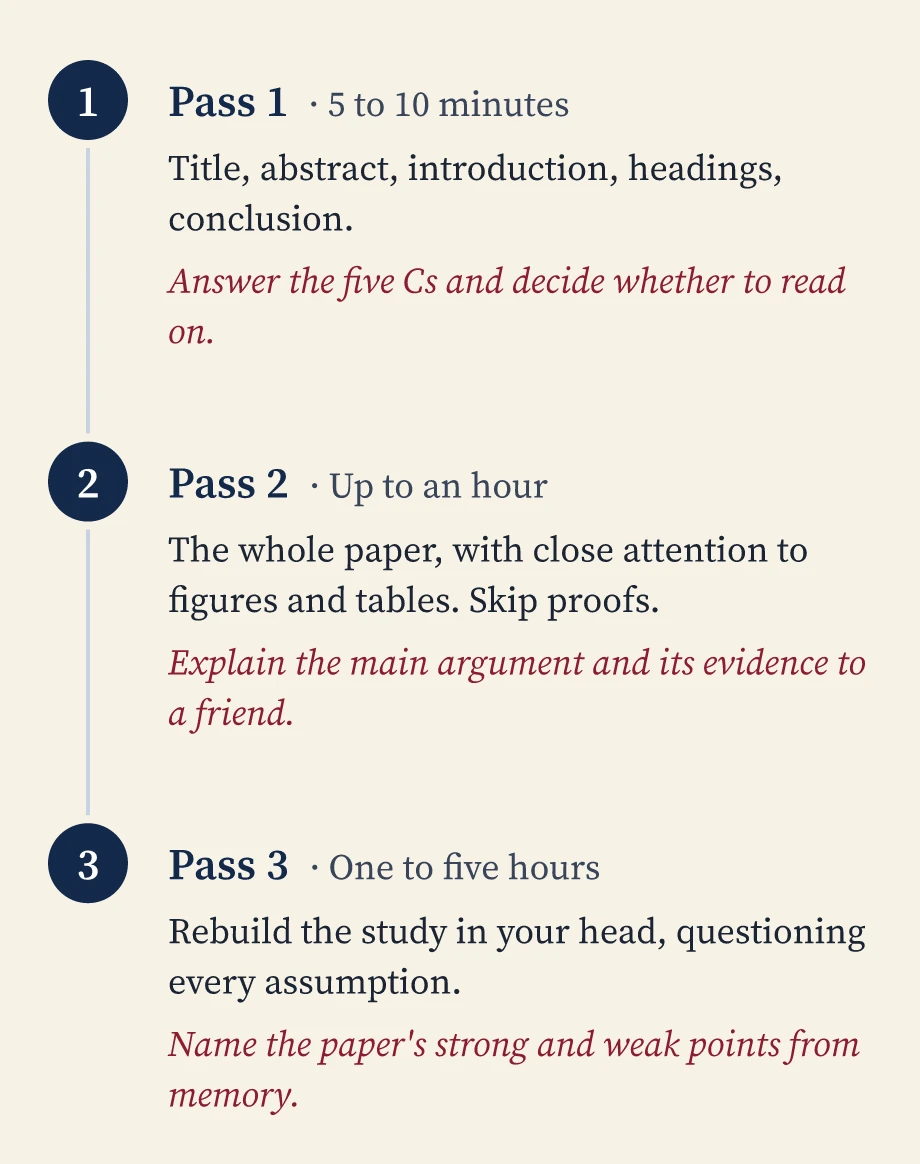
Pass 1: the bird's-eye view (5 to 10 minutes)
The goal is to learn what the paper is about and whether it deserves more of your time. Read only these parts:
- The title, the abstract and the introduction, carefully.
- The section and sub-section headings. Skip everything under them.
- The conclusion.
- The reference list. Glance at it and notice any papers or authors you already know.
Then answer Keshav's five Cs:
- Category: What kind of paper is it? An experiment, a survey of students, an analysis of existing data, a review of other studies?
- Context: What other work does it build on? What ideas or theories does it use?
- Correctness: Do the assumptions seem reasonable?
- Contributions: What does the paper claim to add?
- Clarity: Is it well written?
Often you'll stop here, and that's the point. If the paper is off your topic, or rests on assumptions you don't trust, you've spent ten minutes on it instead of two hours.
Try this: write two sentences, one on what the paper asks and one on what it finds. If you can't, do the first pass again before moving on.
Pass 2: the content (up to an hour)
Now read the whole paper with care, but skip the hardest details, such as mathematical proofs or the fine print of a statistical model. Jot notes in the margins as you go. Two things deserve extra attention:
- Figures and tables. Are the axes labeled? Are the units clear? Do the results show error bars or confidence intervals, so you can tell whether a difference is real or could be chance? Keshav notes that mistakes like these are what separate rushed work from excellent work.
- References you haven't read. If the paper keeps leaning on the same earlier study, that study probably matters for your topic too. Mark it and add it to your reading list.
After the second pass you should be able to explain the paper's main argument, and the evidence behind it, to a friend. For most papers in a first research project, this is enough.
If the paper still doesn't make sense, that's normal. Keshav lists the usual reasons: the subject is new to you, the methods are unfamiliar, the paper is badly written, or it's late and you're tired. You can set it aside, come back after some background reading, or push on to the third pass.
Pass 3: the deep read (one to five hours)
Save this for the few papers your own project depends on. Keshav's idea is to "virtually re-implement" the paper: imagine you're doing the study yourself, make the same assumptions as the authors, and compare your version with theirs. The differences show you both what's new in the paper and what's weak or hidden in it.
As you read:
- Question every assumption. Why this sample? Why this measure? What would change if the assumption were wrong?
- Ask how you would have presented each idea. You'll pick up techniques for your own writing.
- Write down ideas for future work. The gaps you notice here are often where your own research question comes from.
Keshav says this pass can take a beginner four or five hours, and an experienced reader about one. At the end you should be able to rebuild the paper's structure from memory, name its strong and weak points, and spot hidden assumptions, missing citations and problems with its methods.
Using the passes for a literature review
The same method helps when you need to find out what's already known about your topic. Keshav calls this a literature survey:
- Search Google Scholar with a few well-chosen keywords and find three to five recent papers. Do a first pass on each, then read their related-work or literature review sections. If you find a recent review article, read it first.
- Look for papers and authors that keep turning up in those reference lists. Those are the key papers and researchers. Check where those researchers have published recently.
- Look through recent issues of those journals and conferences for related work. Do two passes on everything you've collected, and if they all cite a key paper you missed, get it and read it.
Source: S. Keshav, "How to Read a Paper," ACM SIGCOMM Computer Communication Review 37, no. 3 (July 2007): 83–84. Read the original paper or see the publisher's record.
Want more? Join the Atlas community
Members get every session live, plus recordings, guides and feedback.
Join our DiscordReady to write your own paper? Apply to the Winter Fellowship
Atlas Research Institute is a nonprofit that introduces students to research. In our free six-week online fellowship, students pick an issue they care about, learn to find and test evidence, and finish their first research paper.
Applications close December 21, 2026.
Apply